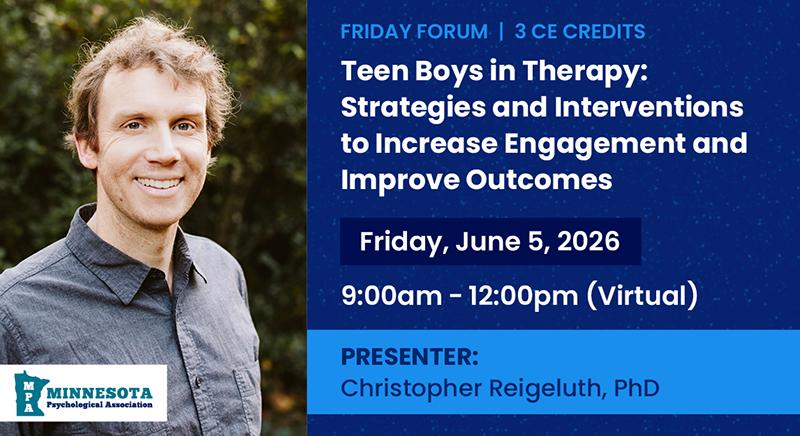
Teen Boys in Therapy: Strategies and Interventions to Increase Engagement and Improve Outcomes
Chris Reigeluth, PhD
Program Overview
When one’s gender socialization includes emotional restriction and being in control as primary teachings, the processes of seeking help and engaging in therapy can be daunting. This is the case for many teenage boys. While boys display clear abilities to make themselves vulnerable during early childhood, their abilities to emotionally express are challenged as they encounter heightened masculinity pressures with the approach of adolescence. Teenagers of all genders currently face unique social factors that further compromise their mental health and well-being, including social media and screen-based stressors, and boys face additional unique threats such as video game dependence. Like other teens, boys are now at greater risk of developing a mood and/or anxiety disorder, and, as a group, they continue to exhibit elevated suicidal risk. Thus, teen boys are highly in need of targeted and improved mental health prevention and literacy building and evidence-based mental health interventions. With teenage boys being a more difficult to engage population, this presentation will focus on providing therapists and counselors with more knowledge about this population, established approaches for more effective therapeutic engagement of boys, and ways to intervene with parents on behalf of teen boys’ improved mental health, well-being, and restrictive familial and societal messaging about masculinity. This presentation will be self-exploratory and reflective with ample opportunities for questions and engaging with the presenter.
Objectives
- Describe multiple factors (including masculine gender socialization) contributing to many boys’ challenges with help seeking, engaging in therapy, and making themselves vulnerable
-
Summarize current research on the current state of boys’ mental health (from anxiety and depression to Internet Gaming Disorder and Autism)
- Assess conformity to masculine norms to use in case formulation and clinical decision-making
-
Identify and apply clinical approaches/interventions for more effective engagement of teen boys in therapy and that contribute to their improved identity development and gender awareness
-
Develop a plan to enlist parents as supporters of teen boys, including ways to help caregivers improve their comprehension of mental health and other issues facing boys and abilities to provide support and help
About the Presenter
Chris Reigeluth, PhD
Christopher Reigeluth earned his PhD in Clinical Psychology at Clark University and is currently is an associate professor and psychologist in the Division of Child and Adolescent Psychiatry at Oregon Health & Science University. He is passionate about providing therapy to kids/teens and works with parents as well. Dr. Reigeluth’s research has focused on masculinities and mental health and ways that dominant masculine gender socialization messages can influence boys’ functioning and well-being. He is author of the “The Masculinity Workbook for Teens: Discover What Being a Guy Means to You.” Dr. Reigeluth’s other research interests include therapy engagement of boys and healthy masculinity interventions and awareness building. He is on the editorial board for Psychology of Men and Masculinities, chairs the APA Division 51 Task Force on Boys in School, and is part of the Professional Advisory Council for Boys’ Club of NY.
The speaker has indicated the following conflict of interest: He is author of the “The Masculinity Workbook for Teens: Discover What Being a Guy Means to You.”
Additional Information
Credit: This program qualifies for 3.0 CE (continuing education) credits.
Level: Introductory: Assumes post-doctoral education status and limited familiarity with topic.
Audience: Designed for psychologists and other mental health professionals.
ACCESSIBILITY ACCOMMODATIONS: If you need disability-related accommodations to make this event accessible, please contact MPA at [email protected]. You can also indicate your needs on the registration form.
CONFIRMATION/CANCELLATION: You will receive an email confirmation of your registration. You will be notified by mail, e-mail or telephone if your selection is full or cancelled.
REFUND POLICY: A 100% refund will be made if the event is cancelled. Refunds, less than a $5 handling fee, will be given if a written cancellation is received at least two working days before the scheduled program begins. No refund or transfer is given the day of the program.
Continuing Education: The Minnesota Psychological Association is approved by the American Psychological Association to sponsor continuing education for psychologists. The Minnesota Psychological Association maintains responsibility for this program and its content.
The Minnesota Psychological Association cosponsors Friday Forums with the Metropolitan State University Psychology Department.
Download the event flyer PDF.